Anime Character Birthdays: Patterns Behind the Dates
Official birthdays are a strange hybrid of authorial whim, marketing calendar, and fan ritual. Here are the patterns—and the verification problem.
 Anime Array Editorial
6 min read
On this page
Anime characters do not have birthdays in the way people do. They have dates assigned to them by authors, editors, guidebooks, and marketing departments—dates that fans then celebrate as if they were real. The strange thing is that it works. A fictional birthday can trend on social media, sell a cafe drink, and make a fandom feel like a calendar instead of a crowd.
That makes character birthdays a useful case study in how anime canon is built. Some dates are deeply thematic. Some are jokes. Some are chosen because the author liked the number. And some are simply marketing decisions that hardened into fact. The patterns are real, but they are weaker than the fan wikis suggest.
What counts as an official birthday?
A birthday is usually treated as canon when it appears in a primary source: a manga volume profile, an official guidebook, a creator interview, a franchise website, or an official social media post. The further you get from those sources, the more likely you are to find a date that is popular, plausible, and wrong.
There is no single registry. Different franchises publish character data in different places, and adaptations can add or change details. A date that is official for the manga may not be repeated in the anime; a date from a guidebook may be contradicted by a later reprint. “Canon” is less like a database and more like a chain of citations.
A small calendar of well-known birthdays
Here are eight dates that are widely listed and easy to verify against official or franchise-adjacent sources. They are not a complete list, and they are not all equally well sourced—but they show the range.
| Character | Series | Birthday |
|---|---|---|
| Monkey D. Luffy | One Piece | May 5 |
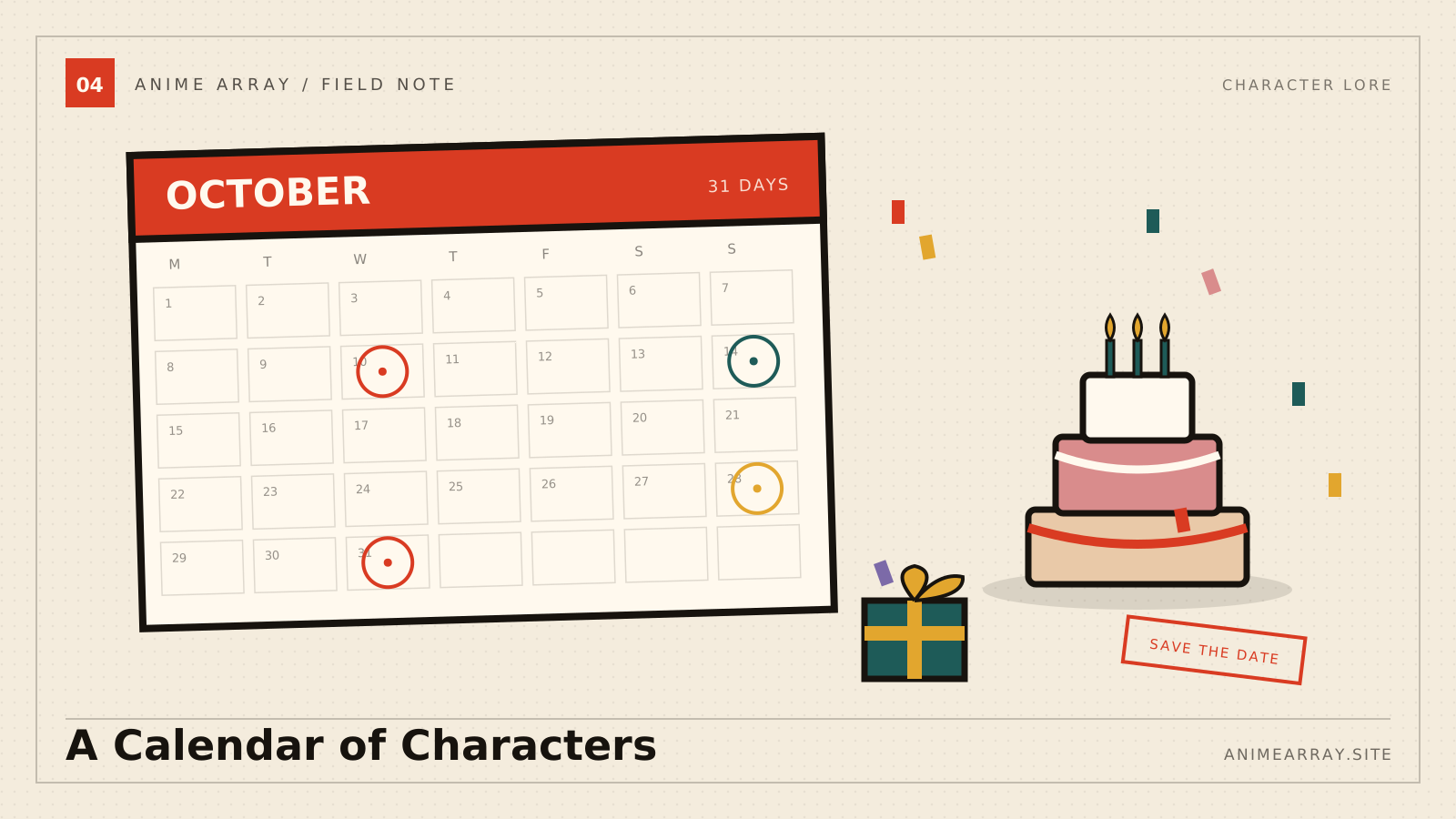
| Naruto Uzumaki | Naruto | October 10 |
| Usagi Tsukino | Sailor Moon | June 30 |
| Levi Ackerman | Attack on Titan | December 25 |
| Tanjiro Kamado | Demon Slayer | July 14 |
| Nezuko Kamado | Demon Slayer | December 28 |
| Satoru Gojo | Jujutsu Kaisen | December 7 |
| Light Yagami | Death Note | February 28 |
Notice how many of these dates are culturally loaded. December 25 is Christmas. June 30 is the midpoint of the year. October 10 is easy to write as 10/10. February 28 is the last day of the shortest month. Even when a date is not explicitly symbolic, it tends to be memorable.
Why dates cluster
There are a few recurring reasons a creator or publisher picks a particular day.
- Thematic resonance. A character associated with fire might be born in summer; a character associated with death might get a date near a holiday; a character with a numeric name might get a date that matches the number.
- The author's own life. Some birthdays are borrowed from the creator, a family member, or a date that matters to the production team.
- Calendar convenience. Dates near holidays are easy to remember and easy to market. They also give official accounts something to post about every year.
- Astrology and personality. Some fans read the birthday as a zodiac clue, and some creators lean into the association. This is usually flavor, not a rule.
- Merchandising. A birthday is a recurring sales event. It creates a reason for new art, limited goods, cafe menus, and collaborations. The date does not have to be meaningful to be useful.
The last point is the one fans often underestimate. A birthday is not just lore. It is a content slot. It gives the franchise a predictable moment of attention every year, and it gives fans a ritual they can participate in.
The birthday economy
In Japan, character birthdays are a regular part of the promotional calendar. Official accounts post new illustrations. Cafes run themed menus. Shops release limited merchandise. Voice actors record messages. Fans organize hashtags, fan art events, and charity drives.
This is not a cynical corruption of the story. It is how a long-running franchise stays present between seasons. A birthday is a small, repeatable event that rewards attention. It also creates a useful test of a character's popularity: if the birthday posts are quiet, the character may not have much of a fandom; if they trend, the franchise has a pillar.
The flip side is that the calendar can start to feel like a schedule. Fans who feel obligated to celebrate every date may burn out. The best approach is to treat birthdays as invitations, not homework.
The verification problem
Birthdays are easy to get wrong because they are easy to repeat. A fan wiki lists a date. A second wiki copies it. A listicle copies the second wiki. Soon the date is everywhere, and it looks official because it is consistent.
If you want to be accurate, work backwards:
- Find the primary source. A manga volume profile, an official guidebook, a creator interview, or a franchise website.
- Note the edition and medium. Manga, anime, film, game, and stage play can differ. Say which one you mean.
- Check the date format. Japanese dates are usually written year/month/day, and fan translations sometimes flip them.
- Separate canon from headcanon. A popular birthday theory is not the same as an official date, even if it is more fun.
This is not just pedantry. If you run a character database, a birthday page, or a fan calendar, accuracy is the product. One wrong date can spread across dozens of sites.
How to build a birthday calendar that does not lie
If you want to make a birthday calendar for a site or a community, treat each entry as a citation, not a fact. Include the source, the medium, and the date you checked it. Mark disputed dates as disputed. Keep a “last verified” field. And do not fill gaps with guesses just to make the calendar look complete.
A smaller, well-sourced calendar is more useful than a large one that quietly invents dates. Fans notice. Search engines notice. Trust is built in the boring parts.
The bottom line
Anime birthdays are a charming hybrid of authorial whim, marketing calendar, and fan ritual. The dates matter because people decide they matter. That does not make them fake; it makes them a perfect example of how canon works in a living fandom.
Celebrate the ones you love. Just check the source before you put the date on a poster.
Frequently asked
Do all anime characters have official birthdays?
No. Many characters have no published date, and some have dates that vary by medium or edition.
Are anime birthdays real?
They are fictional dates officially assigned by creators or publishers. Fans treat them as real rituals, which is what gives them cultural weight.
Why do so many anime characters share birthdays?
Sometimes it is thematic, sometimes it is a marketing decision, and sometimes it is coincidence. A shared date is not proof of a shared personality.
Sources and notes
- Anime Characters Database, “Anime Birthdays.” A large fan-maintained database; useful for discovery, but always check the individual franchise source.
- ufotable, “2026 Birthday Celebration of Tanjiro Kamado.” An official example of a birthday used as a promotional event.
- CBR, “Sailor Moon: When Is Every Sailor Scout's Birthday?” Includes Usagi's June 30 birthday and the in-series celebration.
Dates can vary by edition and adaptation. This article treats the manga, anime, films, and games as separate texts unless stated otherwise. The table is a sample, not a definitive registry.