How Anime Character Names Are Built
A name is the first piece of character design. The best anime names do at least two jobs at once: sound, script, meaning, and silhouette.
 Anime Array Editorial
6 min read
On this page
A name is the first piece of character design the audience receives. Before the voice, before the costume, before the first close-up, there is a word on a page or a screen. In anime, that word is often doing several jobs at once: it has to sound good, look good, mean something, and survive being shouted across a battlefield.
The best anime names are not just labels. They are compressed arguments about who a character is. The trick is learning to read the layers without pretending every name is a secret code.
The four layers of an anime name
Most names are built from some combination of sound, script, meaning, and silhouette.
- Sound. Rhythm, syllable count, and ease of pronunciation. A name that is fun to say is easier to remember and easier to market.
- Script. The kanji, katakana, or hiragana used to write it. Script can signal foreignness, formality, age, or genre.
- Meaning. The literal pieces of the name, plus any puns, references, or numerical readings.
- Silhouette. How the name looks on a page, a poster, or a logo. Short names with strong shapes travel well.
A name that only does one job can still work. A name that does two or three is the kind that sticks.
Surname first, and then the translation problem
Japanese names are traditionally written family name first, given name second. Uzumaki Naruto is Uzumaki (family) Naruto (given). English localizations often flip the order to Naruto Uzumaki to match Western convention, while subtitles and fan translations may keep the Japanese order.
This is not a small detail. The order affects how a name sounds and how it is emphasized. “Uzumaki Naruto” lands differently from “Naruto Uzumaki.” It also affects search: a fan looking for a character may use either order, and a good database should account for both.
Four names, four kinds of work
| Name | Script | Literal pieces | What the name does |
|---|---|---|---|
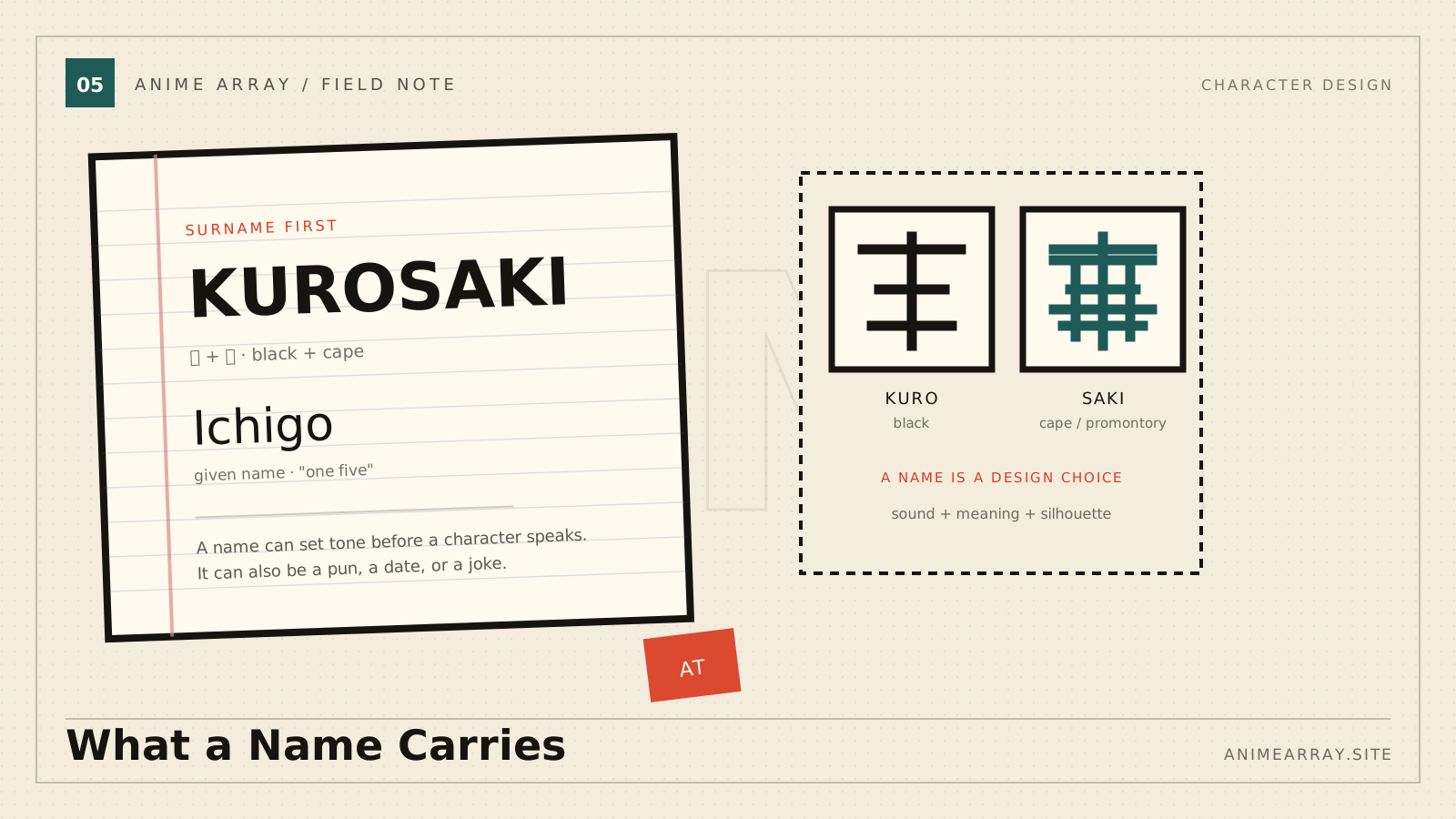
| Kurosaki Ichigo | 黒崎 一護 | 黒 (black) + 崎 (cape/promontory); 一 (one) + 護 (protect) | Sounds ordinary, looks sharp, and hides a “one who protects” reading under a name that can also mean strawberry. |
| Kamado Tanjiro | 竈門 炭治郎 | 竈 (hearth/kiln) + 門 (gate); 炭 (charcoal) | Ties the family to its trade and to fire, home, and the work of turning wood into fuel. |
| Yagami Light | 夜神 月 | 夜 (night) + 神 (god); 月 (moon) | An ironic name for a character who wants to be a god of judgment; the given name is written “moon” but read “Raito.” |
| Uzumaki Naruto | 渦巻 鳴門 | 渦 (whirlpool) + 巻 (scroll/coil); 鳴 (sound) + 門 (gate) | Echoes the whirlpool imagery of the series and the narutomaki fish cake, whose spiral pattern shares the name. |
These readings are not trivia for their own sake. They show how a name can carry theme, family history, and a joke at the same time. They also show why translation is hard: a name that means “hearth gate” in Japanese may mean nothing at all to an English-speaking viewer.
Puns, double readings, and the joy of ateji
Japanese is full of homophones and multiple readings, which makes it a fertile ground for name puns. A character's name can sound like a number, a food, a phrase, or another word entirely. Writers use this deliberately, and fans enjoy decoding it.
Ichigo is the classic example. The sound can mean “strawberry” (苺), and it can also be read as “one-five” (一五). The character Ichigo Kurosaki writes his name 一護, “one who protects,” but the series is happy to let the other readings hover around him. The pun is not a contradiction. It is a layer.
Light Yagami works in the opposite direction. His given name is written 月, “moon,” but it is read “Raito”—a foreign-sounding reading that produces the English word “light.” The character is named after light while carrying the moon in his script. That tension is the character in miniature.
Naruto is another name that keeps folding back on itself. The whirlpool in the title, the spiral in the logo, the fish cake in the ramen, and the place name in the character's surname all rhyme with each other. None of these connections is required to enjoy the story, but together they make the name feel inevitable.
The localization trade-off
When anime travels, names often change. Usagi Tsukino became Serena Tsukino in the DiC English dub. Kuririn became Krillin. Son Goku became Goku. These changes are not all the same kind of decision.
Some changes make a name easier for a new audience to pronounce. Some replace a Japanese pun with an English one. Some erase a cultural reference entirely. The trade-off is accessibility versus specificity, and different localizations draw the line in different places.
Modern subtitles and streaming releases tend to keep Japanese names and order, which preserves the original layers. Dubs often adapt for sound and familiarity. Neither approach is automatically better. The useful question is what the name is doing in the story, and whether the localization preserves that job.
A practical checklist for naming a character
If you are writing or designing a character, the goal is not to produce a name that is clever in isolation. It is to produce one that fits the story and survives contact with an audience.
- Say it aloud. If you stumble, readers will too.
- Check the script. If you are using Japanese, confirm the kanji, the reading, and the meaning with a dictionary. Do not guess.
- Search for collisions. A name that is already attached to a famous character will fight for attention.
- Decide which layer matters most. Sound, meaning, or silhouette? Build around that.
- Leave room for a nickname. Characters rarely use full names in every scene.
- Test it in a sentence. “Tanjiro, behind you!” should sound like something a person would actually shout.
The last test is the most important. A name is not a puzzle box. It is a tool that has to work in dialogue, in a title, in a search bar, and in a fan's memory.
The bottom line
Anime names are built from sound, script, meaning, and silhouette. The best ones do at least two of those jobs, and the great ones make the layers feel natural rather than clever. The next time a name sticks with you, ask which layer did the work. The answer is often the reason the character stuck too.
Frequently asked
Are anime names real Japanese names?
Some are common, some are unusual, and some are invented or puns. Many are chosen for sound and symbolism rather than realism.
Why do anime characters have Western names?
Setting, style, and character background. A Western name can signal foreignness, a fantasy world, or a deliberate contrast with the Japanese cast.
Is Ichigo a real name?
Yes, though it is uncommon. The sound can also mean strawberry or ‘one-five,’ which is part of the wordplay around the character.
Sources and notes
- Jisho.org was used to check the kanji and common readings discussed here, including 黒, 崎, 竈, 門, 炭, 夜, 神, 渦, 巻, 一, and 護.
- TV Tropes, “Meaningful Name.” A catalogue of naming conventions in fiction; useful as vocabulary, not as a primary source for Japanese.
- Wikipedia, “Japanese name.” Background on surname-first order and naming conventions.
Japanese names can have multiple readings, and the same kanji can be read in different ways depending on the name. The readings here follow the official romanizations and common fan usage; they are not a complete dictionary of possible meanings.