Anime Character Heights: Why the Numbers Vary
Anime height charts look official until the animation disagrees. Here is why canon numbers, character art, and on-screen scale rarely match.
 Anime Array Editorial
7 min read
On this page
- Where the numbers come from
- Five characters, five lessons
- Why the numbers conflict
- Art is not a technical drawing
- Perspective changes everything
- Time passes
- Adaptations adapt
- Promotion is not continuity
- The visual cheat
- Height as a storytelling tool
- How to read a height chart responsibly
- A practical note for writers and artists
- The bottom line
- Frequently asked
Anime height charts promise something seductive: a number. Not a vibe, not a range, not a matter of perspective—a number in centimeters, usually printed in a guidebook or a character profile, that tells you exactly how tall a fictional person is. Fans build comparison charts, powerscalers cite the numbers, and fan artists use them to keep characters in proportion.
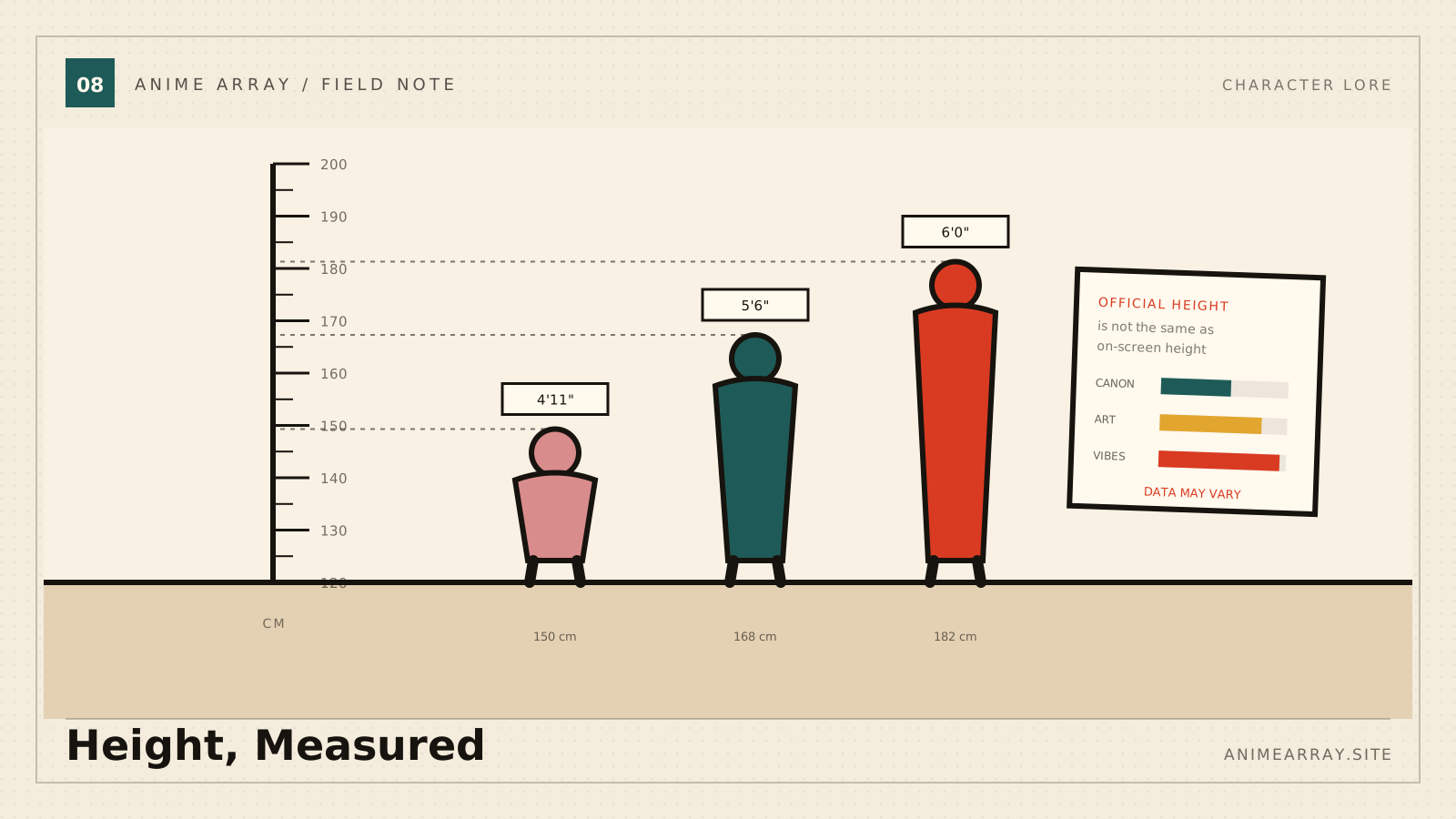
Then the anime itself disagrees. A character who is listed at 160 cm towers over someone listed at 175 cm. A teenager grows twenty centimeters between arcs. A close-up makes a short character look enormous. The numbers are not useless, but they are not the whole story. They are one layer of a negotiation between canon, art, and animation.
Where the numbers come from
Character heights usually enter canon through one of four doors:
- Manga profiles. Character introduction pages, volume extras, and author notes.
- Guidebooks and databooks. Official publications that collect stats, sometimes years after the character was designed.
- Franchise websites and social media. Promotional profiles, birthday posts, and character pages.
- Fan databases. Useful for discovery, but one step removed from the source.
Each door has a different level of authority. A number in a manga volume is usually stronger than a number on a fan wiki. A number in a databook is official, but it may reflect the character at a specific point in the story. A number on a promotional site may be chosen for clarity rather than continuity.
Five characters, five lessons
| Character | Series | Commonly listed height | What it shows |
|---|---|---|---|
| Naruto Uzumaki | Naruto | 147.5 cm (early Part I); 166 cm (Part II); 180 cm (adult) | Heights change across time skips; the chart needs a date. |
| Levi Ackerman | Attack on Titan | 160 cm | A short character can dominate a frame through staging, not scale. |
| Satoru Gojo | Jujutsu Kaisen | 190 cm | Height is part of a power fantasy; the camera often looks up at him. |
| Tanjiro Kamado | Demon Slayer | 165 cm | A grounded number can make a supernatural story feel physical. |
| Monkey D. Luffy | One Piece | 174 cm (pre-timeskip); post-timeskip listings vary between 174 cm and 191 cm depending on the source | The same character can have competing “official” numbers. |
The Luffy case is the most instructive. A fan looking for a single answer will find several, each with a plausible source. The honest response is not to pick the one that sounds best. It is to say which source, which version, and which point in the story you mean.
Why the numbers conflict
There are structural reasons heights rarely match the screen.
Art is not a technical drawing
Character designers draw for composition, not measurement. A character may be drawn taller in a dramatic scene, shorter in a comedy scene, or at whatever height makes the panel work. The “official” number is a reference, not a constraint.
Perspective changes everything
A low camera angle makes a character look powerful and tall. A high angle makes them look small. Wide lenses exaggerate foreground figures; long lenses compress depth. Two characters can be the same height and look completely different depending on where the camera is.
Time passes
Shonen protagonists grow. A height listed at the start of a series may be outdated by the final arc. Databooks often lag behind the story, and adaptations may freeze a character at the age they were when the anime started.
Adaptations adapt
Manga, anime, films, games, and merchandise can all use different models. A film may redesign a character for a new art style; a game may adjust proportions for gameplay readability. These versions are not always meant to be identical.
Promotion is not continuity
Some numbers exist to make a character feel a certain way in a profile: taller, cooler, more imposing. They are marketing as much as lore. That does not make them fake, but it does mean they should be read as part of a presentation.
The visual cheat
Animation has a toolkit for making characters look taller or shorter without changing their canonical height.
- Leg length. Longer legs and a smaller head read as adult and tall.
- Camera height. Looking up at a character makes them loom; looking down makes them vulnerable.
- Blocking. Putting a short character next to a tall one, or on a step, changes the read instantly.
- Costume. Coats, boots, and hats add visual height. Hair can add even more.
- Posture. A straight spine and a raised chin read as tall; a slouch reads as small.
This is why a height chart can feel wrong even when the numbers are correct. The chart measures centimeters. The animation measures presence.
Height as a storytelling tool
Height is never just physical. It shapes how characters relate to each other. A tall character may be framed as a protector, a threat, or an authority figure. A short character may be framed as underestimated, agile, or stubborn. The gap between two characters can be played for comedy, romance, intimidation, or tenderness.
The best shows use height as part of the choreography. A tall fighter has to bend to reach a short one; a short fighter has to find a different angle. A height difference can make a hug look protective or a stare-down look unequal. The number matters less than the blocking.
How to read a height chart responsibly
- Check the source. Manga volume, databook, official site, or fan database?
- Check the date. Which arc, which age, which adaptation?
- Check the units. Centimeters and feet/inches are not always converted precisely.
- Expect variation. A single character can have multiple official numbers.
- Separate canon from presentation. A promotional height is not the same as an on-screen measurement.
If you are making a comparison chart, label the version. “Naruto, Part II, 166 cm” is more useful than “Naruto, 166 cm.” If you are drawing fan art, use the number as a starting point and then trust the composition.
A practical note for writers and artists
Pick a height and keep a reference sheet. Decide whether the number is diegetic (the characters could measure it) or promotional (it exists for the audience). Use props for scale: doors, desks, vehicles, other characters. And do not be afraid to bend the number for a shot. A height chart is a tool, not a cage.
The bottom line
Anime heights are a negotiation between the number on the page and the body on the screen. The number is useful, but it is not the truth. The truth is the composition: who is looking up, who is looking down, and what the story wants you to feel about the difference.
Measure the character if you like. Then watch the frame.
Frequently asked
Are anime heights canon?
They are canon when published in an official source, but they can vary by edition, adaptation, and point in the story. Treat them as versioned data.
Why do anime characters look taller than their listed height?
Camera angle, perspective, leg length, costume, and blocking all change the read. A height chart measures centimeters; a frame measures presence.
Do characters grow during a series?
Sometimes. Time skips and aging can change official heights, and adaptations may freeze a character at a particular age.
Sources and notes
- CBR, “How Tall Are the Naruto Characters?” Lists Naruto's progression from 147.5 cm to 166 cm to 180 cm.
- Anime Characters Database. A fan-maintained database useful for cross-checking character stats; always verify against the franchise source.
- Fiction Units, “Anime Character Height Converter and Comparison.” A useful example of how fan projects reconcile conflicting numbers.
Heights vary by source, edition, and point in the story. The table is illustrative, not a definitive registry. Where sources disagree, this article says so rather than choosing a winner.