Anime Eye Color Meaning: What Each Shade Signals
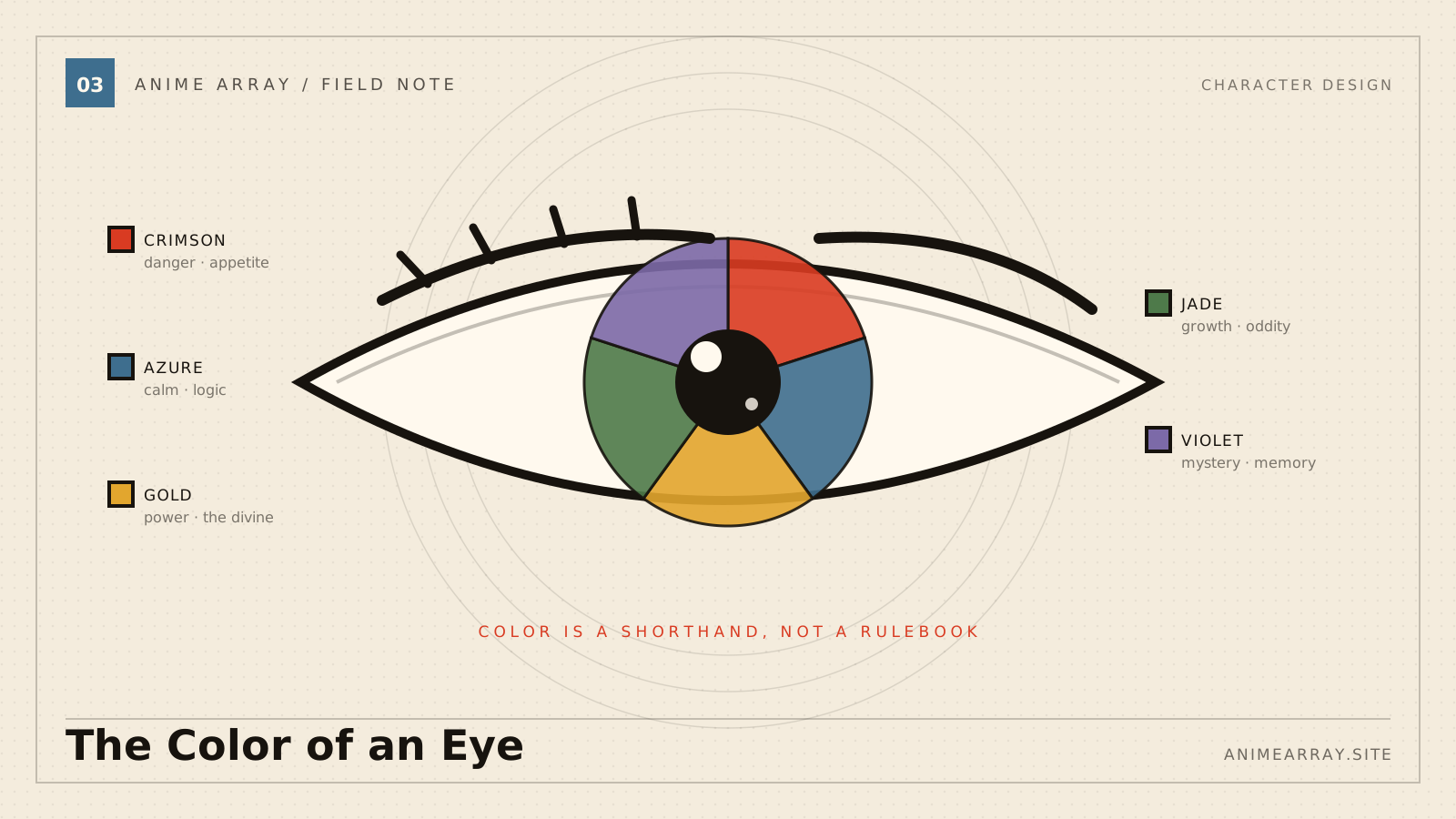
Red eyes, blue eyes, gold eyes: anime uses color as shorthand. But the palette is a language with a loose grammar, not a personality test.
 Anime Array Editorial
7 min read
On this page
Anime loves an eye close-up. The frame tightens, the background falls away, and the iris fills the screen in a color that seems to mean something. Red. Gold. A blue so pale it looks like glass. The character does not have to say a word. The color is doing the talking.
But what is it saying? The honest answer is: it depends. Anime eye color is a design language with a loose grammar, not a dictionary. The same shade can signal danger in one show and warmth in another. The useful skill is not memorizing a chart. It is learning to read the color in context.
The loose palette
Across anime, some associations show up often enough to be useful. They are tendencies, not rules.
| Color | Common signals | Also used for |
|---|---|---|
| Red | Danger, appetite, demonic nature, violence | Passion, intensity, rare power, grief |
| Blue | Calm, logic, distance, melancholy | Coldness, clarity, supernatural perception |
| Green | Nature, growth, curiosity, oddity | Envy, instability, otherness |
| Gold | Divinity, royalty, power, the non-human | Corruption, hunger, something ancient |
| Violet | Mystery, magic, memory, the occult | Elegance, danger, emotional depth |
| Mixed | Duality, hidden self, transformation | Injury, possession, a second nature |
Notice how many of the “also used for” entries are opposites. That is the point. Color is a tool for contrast, and contrast depends on the scene. A red-eyed character in a horror show is a warning. A red-eyed character in a romance might be a sign of heat, life, or stubbornness. The color is not the meaning. The color is the material the meaning is made from.
Same color, different job
Two red-eyed characters can produce completely different feelings. Sebastian Michaelis in Black Butler has red eyes that announce what he is: a demon, a predator, a thing wearing a butler's suit. The color is a threat. Rei Ayanami in Neon Genesis Evangelion also has red eyes, but they read as uncanny rather than evil—she is pale, quiet, and slightly alien, and the red makes her look like she belongs to a different order of being.
Kurapika in Hunter × Hunter pushes the color in another direction. His eyes turn scarlet under intense emotion, and the change is tied to his clan, his grief, and his power. The red is not a villain's flag. It is a wound that becomes a weapon.
Blue works the same way. Cool-toned eyes can read as calm and controlled, as they often do around Levi Ackerman in Attack on Titan. They can also read as distant, clinical, or unnaturally clear. Gojo Satoru's blue eyes in Jujutsu Kaisen are a power marker—the Six Eyes are a rare ability—but they are also beautiful, which makes them unsettling. The color is doing two jobs at once: it signals strength, and it makes him look like he is looking through you.
The production layer
Eye color is also a practical design choice. A character has to be recognizable in a crowd, in a dark scene, in a merchandise lineup, and in a single frame. Color is one of the fastest ways to make a face distinct.
Animators and character designers use it for contrast. A warm eye color against cool hair, or a pale iris against a dark silhouette, makes the face pop. They use it for faction coding: a family, a squad, or a species may share a palette. They use it for readability in low light, where a saturated iris can catch the eye even when the rest of the frame is dim.
And they use it for merchandising. A character with a signature color is easier to brand: the figure, the poster, the phone case, the cafe drink. This is not a cynical point. It is part of how anime exists as a visual medium with a commercial life.
When the color changes
The most interesting eye-color moments are the ones where the color changes. A shift can signal possession, awakening, injury, or a character revealing a self they usually keep hidden.
In Jujutsu Kaisen, Sukuna's red eyes and markings appear when he takes over Yuji's body. The change is not subtle, and it is not meant to be: the face is the same, but the person behind it is not. In Tokyo Ghoul, Kaneki's kakugan turns one eye red, making his dual nature literal. In Hunter × Hunter, Kurapika's scarlet eyes are both a biological fact and a narrative event.
These changes work because the baseline has been established. The audience knows what the character's eyes normally look like, so the shift reads as a rupture. This is a good rule for any visual language: establish the norm before you break it.
How to read eye color in a scene
Instead of asking “what does red mean?” ask these four questions:
- What is the contrast? Is the eye color the brightest thing in the frame, or is it surrounded by similar tones?
- Who else shares it? Does the color belong to a family, a faction, a species, or just this character?
- Does it change? If the color shifts, what triggers it—emotion, injury, power, or another person?
- What is the genre asking you to feel? Horror, romance, and action all use the same palette differently.
The answers will tell you more than any universal chart. Color is relational. It means something in a frame, next to other colors, in front of a particular story.
The limits of the code
It is worth saying plainly: eye color is not a personality test. It does not reliably predict whether a character is kind, cruel, smart, or sad. It is a design choice, and design choices are shaped by fashion, genre, budget, and the tastes of the people making the show.
Eye color can also change between adaptations. A manga cover, a TV series, a film, and a game may use different palettes. Lighting changes it further: a blue eye in a warm scene can look grey, and a red eye in shadow can look brown. If you are trying to identify a character's “canon” eye color, check the source material and the specific adaptation you are watching.
The bottom line
Anime eye color is a shorthand, not a rulebook. It works because audiences are good at reading contrast, context, and change. The next time a close-up lands, do not ask what the color “means” in general. Ask what it is doing in this frame, for this character, at this moment.
That is where the real meaning lives.
Frequently asked
Does red eye color mean a character is evil?
No. Red is often used for danger or demonic nature, but it also signals passion, grief, rare power, or otherness. Context matters more than the color.
Is heterochromia always special?
In anime, it is often used to signal a dual nature or hidden power, but it can also be a purely aesthetic choice. Do not assume it is a plot point.
Can eye color tell you a character's personality?
Not reliably. It is a design shorthand shaped by genre, contrast, and merchandising, not a personality test.
Sources and notes
- TV Tropes, “Color-Coded Eyes.” A catalogue of common associations; useful as vocabulary, not as a universal rule.
- TV Tropes, “Red Eyes, Take Warning.” Documents the red-eye convention and its many exceptions.
- TV Tropes, “Technicolor Eyes.” On unnatural eye colors as a design convention.
Character examples are described from the works themselves. Eye colors can vary between manga, anime, films, games, and merchandise; this essay treats those versions as separate visual texts.