Anime Filler, Explained Without the Snobbery
Filler is a production category, not a quality category. Here is what it is, what it is not, and how to decide what to skip.
 Anime Array Editorial
6 min read
On this page
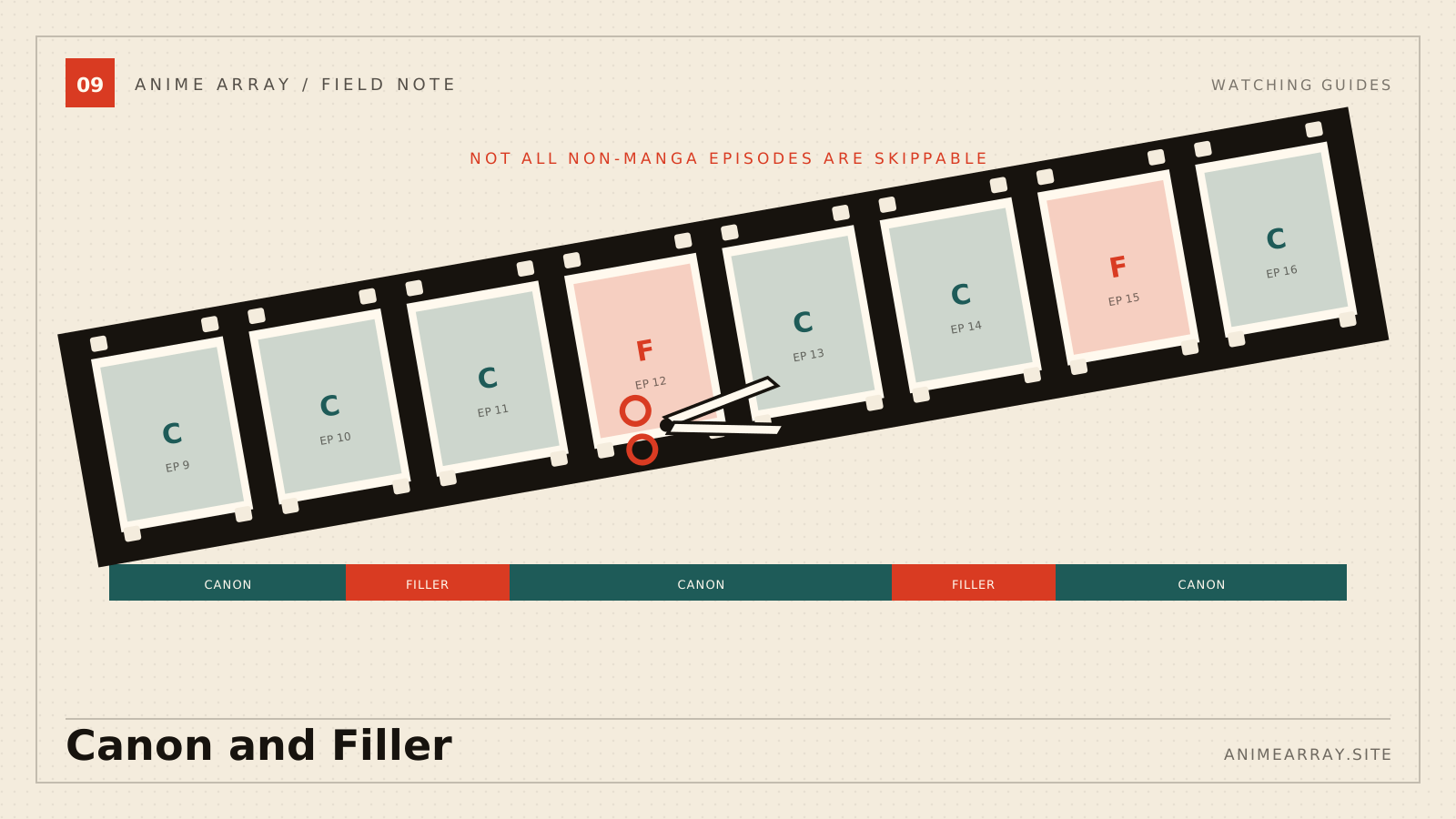
“Is it filler?” is one of the most common questions in anime fandom, and one of the most misleading. The question sounds objective, like asking whether an episode is canon. But filler is a production category, not a quality category. An episode can be anime-original and essential. An episode can be manga-canon and disposable. The label tells you where the material came from, not what it does.
That distinction matters if you are deciding what to watch. It matters even more if you are trying to understand how anime gets made.
What filler actually is
In the most common sense, filler is material created for the anime that did not appear in the source manga. It exists for a practical reason: a weekly anime can catch up with a monthly or weekly manga. When the adaptation runs out of source material, the production has a few options. It can pause. It can adapt a side story. It can create a new arc. It can pad existing material with recaps, extended reactions, and repeated flashbacks.
All of those are sometimes called filler, but they are not the same thing. A useful taxonomy:
| Type | What it is | Skip risk |
|---|---|---|
| Manga canon | Material adapted from the source | Usually essential, but pacing can still be padded |
| Anime-original arc | A new story created for the anime | Varies widely; some arcs are excellent, some are disposable |
| Padded canon | Canon events stretched with recaps, stares, and repeated shots | Low story risk, high boredom risk |
| Recap episode | A compilation of previous events | Usually skippable unless you need a refresher |
| Mixed | Canon material with original scenes woven in | Depends on which parts are original |
The word “filler” flattens all five into one bucket. That is why the debate goes in circles.
Why filler exists
Filler is usually a schedule problem before it is a creative one. Television anime is produced on tight deadlines, often with multiple episodes in various stages of completion at once. If the manga is only a few chapters ahead, the anime cannot adapt faster than the source without catching up. A pause is expensive; a new arc keeps the slot filled and the staff employed.
There is also an economic dimension. A long-running anime is a marketing engine for the manga, games, and merchandise. Keeping the show on the air keeps the franchise visible. Filler is one of the costs of that model—sometimes a cost paid by the story, sometimes a chance for the staff to experiment.
When filler works
The best anime-original material does something the manga could not do at that moment: it gives a supporting character a spotlight, explores a relationship, or lets the world breathe. It may not be “canon,” but it is coherent. It feels like it belongs.
One Piece's G-8 arc is a common example. It is anime-original, and many fans consider it one of the better arcs of its era because it uses the crew's dynamics well and gives the story a self-contained adventure. Bleach's Zanpakuto Rebellion arc is more divisive, but it has defenders for the same reason: it takes the show's existing rules and asks a new question with them.
Filler can also be a pressure valve. A comedy episode in the middle of a grim arc can be a relief. A quiet character episode can make a later loss land harder. The mistake is assuming that “not in the manga” means “not part of the experience.”
When filler fails
Filler fails when it has nothing to do but fill time. The signs are familiar: stakes that reset at the end of the episode, characters acting out of character because the plot needs a conflict, animation shortcuts, and a story that interrupts a climax to go on a side quest.
The problem is not that the material is original. The problem is that it is not about anything. A filler arc that develops a relationship can be more valuable than a canon arc that repeats the same fight. A padded canon episode can be worse than a well-made original one.
How to decide what to skip
Watch-order guides and filler lists are useful, but they are not a substitute for your own judgment. A few questions help:
- Does this episode develop a character or relationship? If yes, it may be worth watching even if it is original.
- Does it change the world or the rules? If it introduces something the story later uses, it matters.
- Is it interrupting a climax? This is the most common reason to skip; pacing matters.
- Do you like the characters enough to spend time with them? Filler is often character content. If you are here for the characters, it may be the point.
- Are you watching for the plot or for the vibe? Neither is wrong. The answer changes the calculation.
If you are following a guide, look for one that explains why an episode is marked skippable. A list that says “filler” without context is not a guide; it is a warning label.
The canon snobbery problem
There is a strain of fandom that treats canon as a moral hierarchy. Manga is real; anime-original is fake; filler is a waste of time. This is understandable—people want to experience the “true” story—but it turns a hobby into homework.
Canon is a useful concept for understanding adaptation. It is not a measure of worth. Some of the most beloved anime scenes are anime-original. Some of the most tedious episodes are panel-for-panel adaptations. The question is not “is this canon?” but “is this good, and is it good for me right now?”
The bottom line
Anime filler is a production category, not a verdict. It exists because television is a schedule, manga is a source, and animation is expensive. Some of it is disposable. Some of it is wonderful. The useful skill is not memorizing a list; it is learning to tell the difference between an episode that fills time and one that fills in the world.
Watch the story you want to watch. Just know what you are skipping, and why.
Frequently asked
Is filler always bad?
No. Filler is a production category, not a quality judgment. Some anime-original arcs are excellent; some canon episodes are padded.
Can I skip filler?
Yes, but check what you are skipping. A filler episode can develop a character or relationship that later matters emotionally, even if it is not plot-critical.
Is anime-original the same as filler?
No. Filler is usually anime-original material created to fill time, but not all anime-original material is filler. Some is intentional worldbuilding or a deliberate alternate story.
Sources and notes
- Anime Filler List. A long-running community project that marks canon, filler, and mixed episodes. Useful as a starting point, not a final authority.
- TV Tropes, “Filler.” Documents the production context and the many ways the term is used.
- Anime News Network Encyclopedia. Useful for checking episode counts, staff, and adaptation details.
Filler classifications are community judgments, not official labels. Different guides draw the line in different places, especially for mixed episodes and anime-original arcs.