Anime MBTI Types: What the Typings Get Right
Anime MBTI typings are fan-made, inconsistent, and weirdly useful. Here is what the four axes can tell you—and where the typings go wrong.
 Anime Array Editorial
7 min read
On this page
- What MBTI is, briefly
- How anime typings are made
- Why it is useful anyway
- Where the typings go wrong
- 1. Typing by stereotype
- 2. Confusing role with type
- 3. Equating shyness with introversion
- 4. Ignoring character growth
- 5. Presenting headcanon as canon
- How to type a character responsibly
- Type is not role
- The bottom line
- Frequently asked
Search any popular anime character's name followed by “MBTI” and you will find a verdict. Sometimes it is a confident four-letter code. Sometimes it is a 600-post forum argument. Sometimes it is a fan wiki entry that cites another fan wiki entry. The codes feel official, even though almost none of them are.
Anime MBTI typings are fan-made, inconsistent, and weirdly useful. They are a vocabulary for talking about how characters think, decide, and clash. They are also a great example of what happens when a psychological framework escapes the clinic and becomes a fandom game.
What MBTI is, briefly
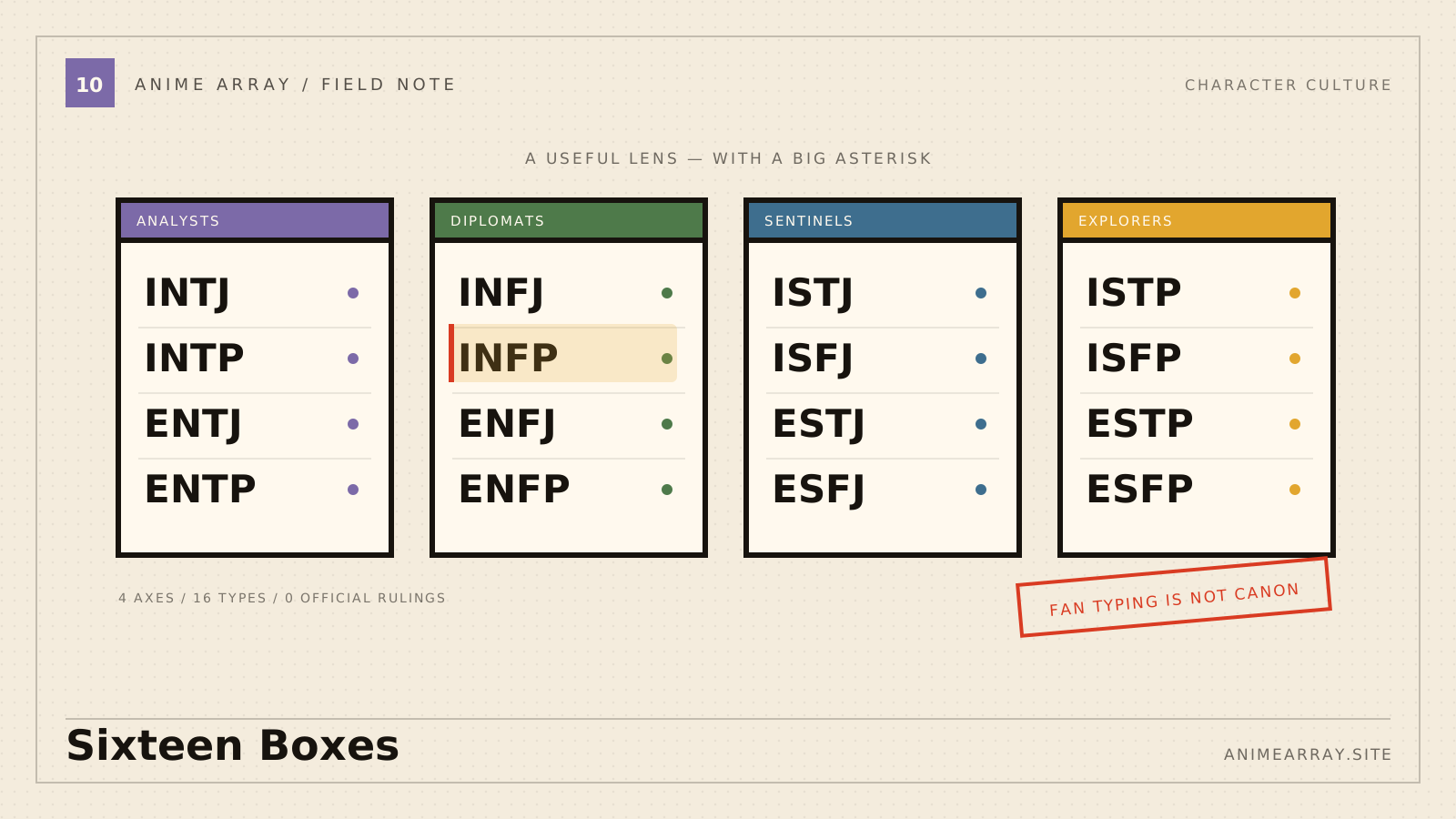
The Myers–Briggs Type Indicator is a personality framework based on Carl Jung's ideas about psychological types. It sorts people along four dichotomies:
- Extraversion (E) / Introversion (I): where attention and energy tend to go.
- Sensing (S) / Intuition (N): how information is taken in—concrete details or patterns and possibilities.
- Thinking (T) / Feeling (F): how decisions are made—logic and consistency or values and impact on people.
- Judging (J) / Perceiving (P): how the outer world is approached—structure and closure or flexibility and openness.
The result is one of sixteen four-letter types. The framework is popular in workplaces, schools, and online quizzes. It is also widely criticized by personality researchers for weak test–retest reliability, limited predictive validity, and a tendency to sort people into boxes that do not capture how behavior changes across contexts. It is not a clinical diagnostic tool, and it should not be treated as one.
That does not make it useless for fiction. It makes it a lens—useful for description, dangerous as a verdict.
How anime typings are made
Most anime typings follow a similar path. A fan watches the character, infers their preferences from behavior, proposes a type, and posts it. Other fans agree, disagree, or propose alternatives. A site like Personality Database collects votes and comments. Eventually a consensus emerges, and that consensus is repeated as if it were canon.
The process is not stupid. It is a form of close reading. Fans are paying attention to how a character handles stress, makes decisions, and relates to other people. The problem is that the output looks more authoritative than the input. A community vote is not an official profile.
Why it is useful anyway
MBTI is a compact way to describe contrasts. If one character leads with logic and another leads with values, the codes give you a shorthand for that difference. If a group has a planner, a improviser, a dreamer, and a pragmatist, the four axes help you name the chemistry.
For writers, the framework can be a prompt generator. It asks questions like: How does this character take in information? What do they trust when they are scared? What kind of decision feels natural to them, and what kind feels like a stretch? Those questions are useful even if you reject the framework's scientific claims.
| Axis | Question | Writing prompt |
|---|---|---|
| E / I | Where does the character recharge? | Put them in a crowded room and watch what they do after an hour. |
| S / N | What do they notice first? | Show them the same scene twice: once as details, once as implications. |
| T / F | What do they trust in a hard choice? | Give them a decision where logic and loyalty point in different directions. |
| J / P | How do they handle an open ending? | Give them a plan that falls apart and see what they reach for. |
Where the typings go wrong
Most bad anime typings fail in one of five ways.
1. Typing by stereotype
“INFP = sad soft boy.” “INTJ = cold genius.” “ESTP = dumb jock.” These are not types; they are tropes. A character can be quiet without being an introvert, analytical without being a thinker, or chaotic without being a perceiver. Behavior is context-dependent, and fiction is full of exceptions.
2. Confusing role with type
A villain is not automatically an INTJ. A mentor is not automatically an INFJ. A comic relief character is not automatically an ESFP. Role describes the story's function; type describes a pattern of preference. They can align, but they are not the same axis.
3. Equating shyness with introversion
Introversion is about where energy is directed, not how socially skilled someone is. A character can be shy and extraverted, or confident and introverted. Anime loves the quiet loner, which makes this confusion especially common.
4. Ignoring character growth
A character at the start of a story may not be the same at the end. A typing that describes episode one may be wrong by episode twenty-four. Good fiction changes people; a static code can miss the arc.
5. Presenting headcanon as canon
Unless the creator has explicitly assigned a type, every anime MBTI is an interpretation. That does not make it bad. It makes it a fan reading. Label it as one.
How to type a character responsibly
- Watch behavior under stress. Preferences are clearest when a character is under pressure.
- Separate functions from stereotypes. Ask what the character trusts, not what aesthetic they fit.
- Consider the arc. Type the character at a specific point in the story, and say which point.
- Cite the source of the typing. Fan consensus, a poll, or a creator statement are different kinds of evidence.
- Hold it loosely. A type is a hypothesis, not a verdict.
The best fan typings read like character analysis, not like a diagnosis. They explain why a dynamic works, where a character surprises us, and what the code leaves out.
Type is not role
One of the healthiest things about anime MBTI is that it can break stereotypes if you let it. Heroes can be any type. Villains can be any type. A quiet strategist can be the heart of the team; a loud idealist can be the one who makes the hard call. The interesting question is not “what type is this character?” but “how does this character's way of thinking create friction with the people around them?”
That is where the framework earns its keep. Not as a label, but as a way to describe the machinery of a relationship.
The bottom line
Anime MBTI typings are a fan-made lens on character behavior. They are not canon, not clinical, and not stable enough to be a personality test. They are useful when they help you see a character more clearly, and harmful when they replace the character with a label.
Use the code to ask better questions. Then put the code down and watch the character.
Frequently asked
Are anime MBTI types official?
Almost never. Unless the creator has assigned a type, anime MBTI typings are fan interpretations and community consensus.
Is MBTI scientifically valid?
It is a popular framework with well-documented criticisms about reliability and predictive validity. It is not a clinical diagnostic tool. Use it as a lens, not a verdict.
What is the rarest MBTI type in anime?
There is no reliable data. Anime characters are written for story needs, not sampled from a population, so any ‘rarest type’ claim is a fan generalization.
Why do so many people type the same character differently?
Because behavior is context-dependent, fans weigh different scenes, and the framework itself is imprecise. Disagreement is built into the exercise.
Sources and notes
- The Myers-Briggs Company, “MBTI Basics.” The official framework and its four dichotomies.
- Randy Stein and Alexander Swan, “Evaluating the Validity of Myers-Briggs Type Indicator Theory” (2019). A peer-reviewed critique of the theory behind the instrument.
- Personality Database. A fan-run voting site for character typings; useful as a record of fan consensus, not as an official source.
No character typing in this article is presented as official. MBTI is a popular framework with well-documented scientific limitations; this essay treats it as a tool for character analysis, not as a psychological assessment.