The 5 Beats of a Great Anime Redemption Arc
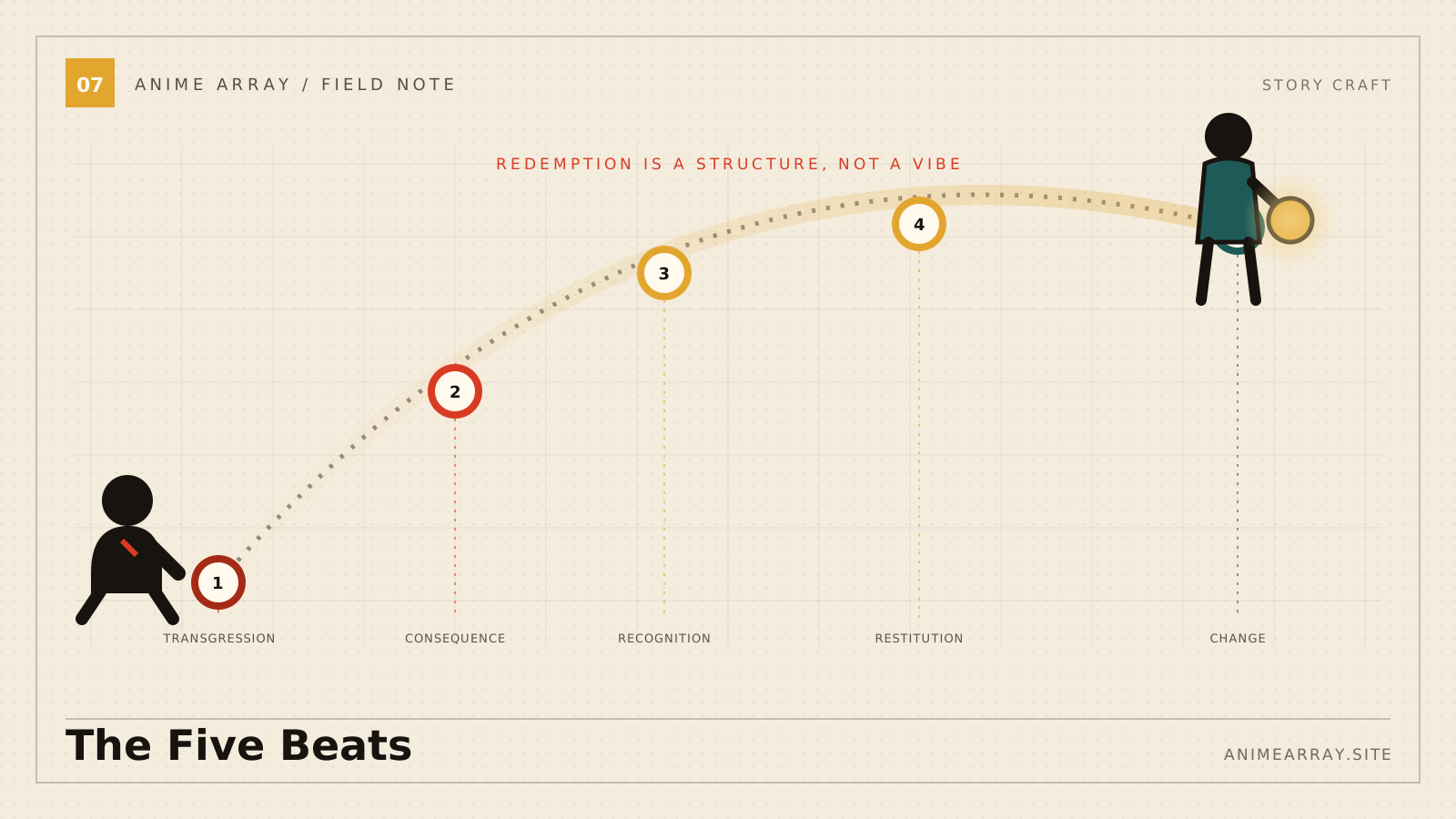
A redemption arc needs more than a sad backstory. These five beats—transgression, consequence, recognition, restitution, change—make it land.
 Anime Array Editorial
7 min read
On this page
- The five beats
- 1. Transgression
- 2. Consequence
- 3. Recognition
- 4. Restitution
- 5. Change
- Why the order matters
- Four case studies
- Zuko: the clean template
- Vegeta: the long arc
- Endeavor: the unfinished arc
- Itachi: revelation is not redemption
- Redemption is not forgiveness
- The backstory trap
- A worksheet for writers
- The bottom line
- Frequently asked
Every few seasons, a fandom adopts a villain. The fan art gets softer. The discourse gets defensive. Someone writes a long thread explaining that the character was actually a victim, and that the story owes them a happy ending. Sometimes the story agrees. Sometimes it does not.
The difference between a redemption arc and a sympathy campaign is structure. A sad backstory can make a character understandable, but it cannot make them redeemed. Redemption is a sequence of choices that costs the character something; when a story skips the cost, the audience feels it.
Spoiler note. This essay discusses character arcs in general terms, with light spoilers for Avatar: The Last Airbender, Dragon Ball, My Hero Academia, and Naruto.
The five beats
Most redemption arcs that land follow a version of this sequence. The order matters more than the screen time.
1. Transgression
The character has to do something that matters, and the story has to show the harm, not just announce it. A villain who hurts a person the audience knows is more compelling than one who conquered a city in a flashback. Transgression establishes the debt.
2. Consequence
The cost has to be concrete: a home, a role, a relationship, a sense of self. Consequence separates a redemption arc from an apology tour. If nothing is lost, nothing is at stake.
3. Recognition
The character names the harm without excuses. This is the beat most arcs fail. Recognition is not “I had a difficult childhood.” It is “I did this, it was wrong, and I understand why it hurt you.” The character has to see the harm from the outside.
4. Restitution
The character acts to repair what can be repaired. Restitution is not an apology. It is a change in behavior that costs the character something. Sometimes repair is impossible; the character can still protect others or sacrifice something they wanted.
5. Change
The character behaves differently under pressure. This is the proof. Anyone can be kind when things are easy. The arc is complete when the character chooses the new way when the old way would be more convenient.
| Beat | Question it answers | Failure mode |
|---|---|---|
| Transgression | What did they do? | The harm is vague or off-screen |
| Consequence | What did it cost? | The character keeps everything they wanted |
| Recognition | Do they understand the harm? | Excuses, self-pity, or a tragic backstory monologue |
| Restitution | What are they doing to repair it? | A speech replaces action |
| Change | Who are they now under pressure? | The arc resets when the plot needs a villain |
Why the order matters
Skip recognition and you get woobification: the fandom forgives a character the story has not asked them to forgive. Skip restitution and you get cheap grace: an apology is treated as repair. Skip consequence and the arc has no stakes.
The order also protects the victims. A redemption arc that rushes to the villain's feelings can leave the people they hurt as props. The best arcs keep the victims in the frame, so the repair is for them, not just for the villain's conscience.
Four case studies
Zuko: the clean template
Zuko in Avatar: The Last Airbender is the most widely taught example for a reason. His transgression is concrete: he hunts the Avatar and hurts people. His consequence is exile, loss of status, and failure. His recognition is specific: he stops blaming his father and names his own choices. His restitution is action: he teaches Aang, faces his sister, and takes responsibility for the Fire Nation. His change is tested under pressure.
Avatar is not anime, but the structure is the same one anime uses.
Vegeta: the long arc
Vegeta in Dragon Ball is a redemption arc stretched over decades. He starts as a genocidal prince, joins the heroes for convenience, and gradually becomes someone who cares about more than himself. The arc is uneven because the series keeps needing him to be dangerous, but the best beats are unmistakable: his recognition of Goku's superiority, his sacrifice against Majin Buu, and his refusal to go back.
Vegeta shows that a redemption arc does not have to be tidy. It can be long, repetitive, and interrupted by the plot; what matters is that the character keeps moving.
Endeavor: the unfinished arc
Endeavor in My Hero Academia is a useful contrast because his arc is about restitution without easy absolution. He harmed his family in ways that cannot be undone. The story makes him confront that harm, and it does not pretend a single heroic act fixes it. His family's responses vary: some want distance, some want to try, some are not ready. The arc is ongoing, and some debts are not paid in a single season.
Itachi: revelation is not redemption
Itachi in Naruto is a case of a story revealing new information about a character's past and letting the audience re-read his actions. The reveal is powerful, but it is not a redemption arc: the character does not go through recognition, restitution, and change on screen; the audience does the re-reading. That can be satisfying, but confusing the two is how fandoms end up arguing about whether a character was “redeemed” when the story never claimed they were.
Redemption is not forgiveness
A character can be redeemed without being forgiven. Redemption is about the character's relationship to the harm they caused. Forgiveness is about the victim's relationship to the harm. The two can overlap, but they do not have to.
Some of the best arcs end with the character doing the work and the victim choosing not to reconcile. That is not a failure; repair is not reunion. The audience can understand a character without absolving them, and the story can leave a relationship broken without leaving the character unchanged.
The backstory trap
A tragic backstory explains a character. It does not redeem them. Explanation is emotionally satisfying: it makes the audience feel sorry for the villain, and sympathy can masquerade as resolution. But the five beats are about what the character does after the explanation. The backstory is context. The arc is action.
This is why the best redemption arcs give the character a moment where they could use their backstory as an excuse—and they do not.
A worksheet for writers
- What is the specific harm? Name the act, the victim, and the consequence.
- What does the character lose? Make it cost something they cannot easily replace.
- What do they admit, and to whom? Recognition should be spoken to a person who was hurt, not just to the audience.
- What action proves the change? Restitution should be costly and concrete.
- What pressure tests the new self? The final beat should put the character in a situation where the old choice would be easier.
The bottom line
A redemption arc is a structure, not a vibe. It needs a real transgression, cost, recognition, repair, and change. When those beats are earned, the audience will follow a character almost anywhere; when they are skipped, no amount of sad music will close the gap.
The best arcs do not ask the audience to forget. They ask the audience to watch someone become worthy of being remembered differently.
Frequently asked
How long should a redemption arc be?
As long as it takes to earn the five beats. A short arc can work if the scope is narrow; a long arc can work if it keeps moving. Length is not the measure; cost and change are.
Can a villain be redeemed in one episode?
Only with a very narrow scope, such as a single act of repair. A full arc needs room for consequence, recognition, and change.
Is redemption the same as forgiveness?
No. Redemption is the character’s relationship to the harm; forgiveness is the victim’s choice. A character can be redeemed without being forgiven.
Sources and notes
- TV Tropes, “Redemption Quest.” A catalogue of stories about characters seeking to atone; useful as vocabulary, not as a primary source.
- TV Tropes, “Heel–Face Turn.” On the difference between a change of allegiance and a full redemption arc.
This is a craft essay, not a claim that every redemption arc must follow these beats exactly. The five-beat model is a diagnostic tool; great stories often bend it.