The Anime Toast Run, Explained
Toast in mouth, running late, crashing into a future friend: the toast run is a three-in-one opening. Here is why it works, where it came from, and why it refuses to die.
 Anime Array Editorial
7 min read
On this page
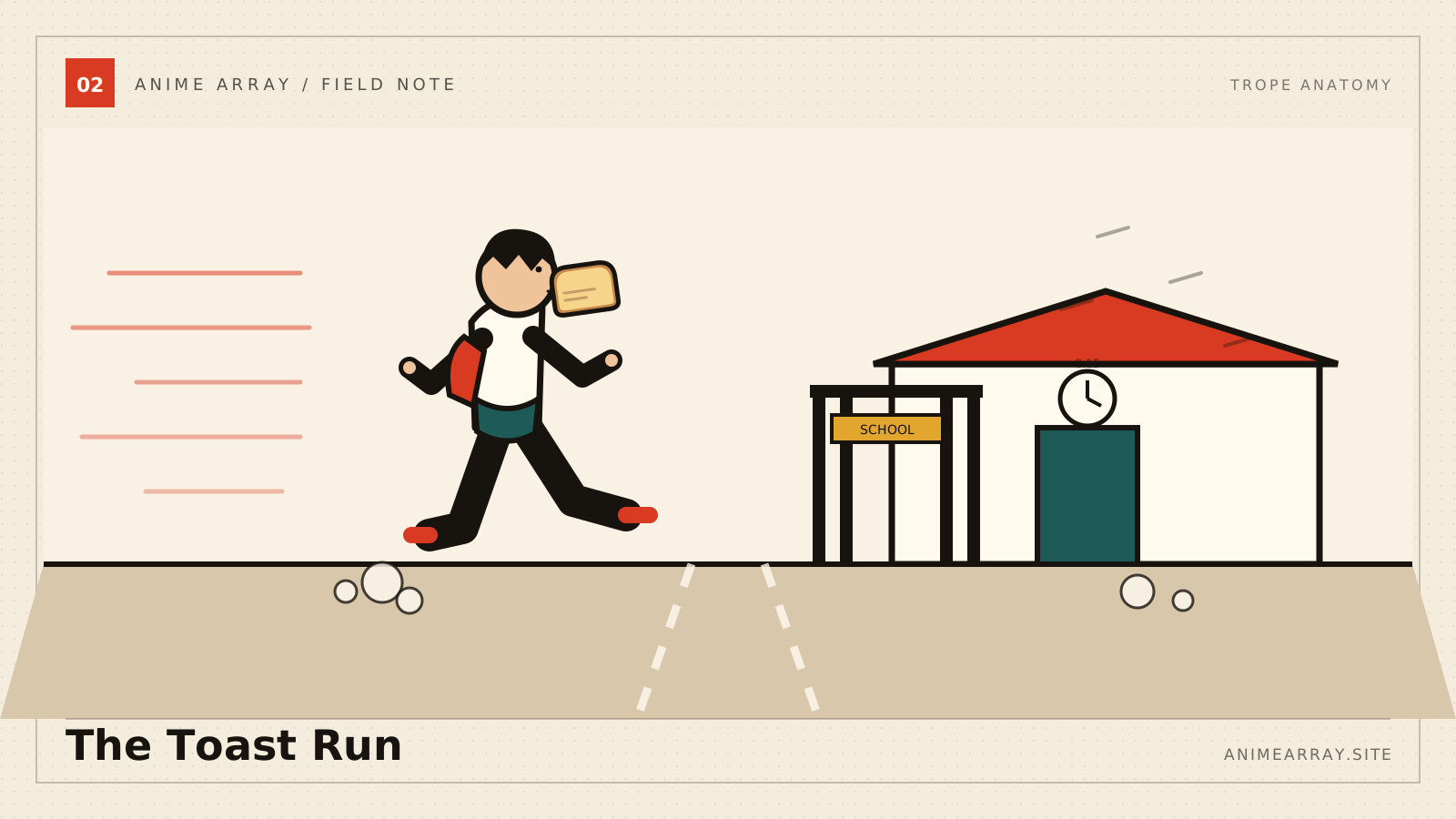
A slice of toast. A school uniform. A character running at full sprint with breakfast clamped between their teeth. If you have watched more than a handful of anime, you can picture the shot before it arrives: the speed lines, the corner turn, the inevitable collision with someone who will matter later.
The toast run is easy to dismiss as a cliché. It is one. But it is also an efficient piece of visual storytelling: a time stamp, a personality sketch, and a plot device in one readable image. Understanding why it works is a good way to understand how anime communicates in general.
What the trope actually is
The full pattern has three beats. A character wakes up late. They grab a piece of toast, put it in their mouth, and run out of the house. On the way to school, they crash into someone—often a future friend, rival, or love interest—and the story begins.
Not every example has all three beats; some characters are already running, carry the toast in hand, or are not late at all. The constant is the image: food in mouth, motion, urgency. It is a visual sentence that means “this person is about to have a day.”
Where it comes from
The toast run is usually traced to 1970s shoujo manga, where the rushed school morning became a standard opening. The comedy manga Even a Monkey Can Draw Manga later boiled the formula into a joke: the heroine screams that she is late, runs out, and chews toast. By the time Project A-ko used the image in 1986, it was already a parody. The trope was old enough to mock before many of its current fans were born.
Bread has a specific history in Japan. Portuguese traders introduced it in the sixteenth century, but it did not become an everyday staple until much later. In the early twentieth century, toast carried a whiff of the modern and the urban: city life, cafés, a changing diet. A slice in a character's mouth is not just breakfast; it signals a contemporary, ordinary, slightly aspirational world.
Why toast, and not rice?
This is the practical question, and it has a practical answer. A traditional Japanese breakfast might include rice, miso soup, grilled fish, and pickles. It is delicious and it is terrible for a running shot. Rice needs a bowl and chopsticks. Soup needs two hands and a table. Fish needs attention.
Toast is the opposite. It is portable, it can be eaten with one hand, and it has a shape that reads clearly even in a small frame or a fast pan. It also fits in a character's mouth, which frees both arms for the run, the bag, and the collision. The toast is not chosen because it is the most realistic breakfast. It is chosen because it is the most cinematic one.
| Job | What the image tells us | Why it works |
|---|---|---|
| Time stamp | It is late; the day has already started without them | No clock, narration, or dialogue needed |
| Character sketch | Disorganized, hungry, ordinary, maybe a little chaotic | Flaws are more likeable than competence in an opening scene |
| Plot device | Someone is about to be knocked into | The collision creates a relationship without a formal introduction |
The third job is the one that turns a gag into a story engine. The crash-into-hello is a meet-cute with physics. It gives two characters a reason to speak, an excuse to touch, and a shared embarrassment. The toast is the fuse.
The physics problem
Here is the thing about running with toast in your mouth: it does not work very well. The bread falls out. It gets soggy. It blocks your breathing. Your hands are free, but your dignity is not. Anime knows this, and the best examples acknowledge it.
In Black★Rock Shooter, a character is told that running around in public with toast in her mouth is rude; she says she has always wanted to try it. In Daily Lives of High School Boys, the toast run is parodied with a character eating curry while running, and another slurping noodles. In K-On!, Yui dashes out with toast—and turns out to be an hour early. The trope is not a documentary. It is a convention, and the jokes come from treating it as one.
There is also a real cultural note underneath the comedy. Eating while walking is generally considered a faux pas in Japan—tabearuki—and the image of a student sprinting with toast is a deliberate exaggeration of bad manners. The joke is that she is doing something slightly improper, in public, at speed.
The genre misdirect
Because the toast run is so recognizable, it can be used as a promise. A show opens with a cheerful student, a slice of toast, a sunny morning, and a collision with a cute classmate. The audience thinks: I know this story. Then the show does something else entirely.
Puella Magi Madoka Magica is the famous example. Its first episode is often read as a deliberate deployment of magical-girl normalcy—the toast run included—so that the turn into something darker lands harder. The trope is not the joke. The trope is the setup that makes the subversion possible.
This is the highest use of a cliché: not to hide the lack of ideas, but to create a shared expectation that the story can then break.
The decline, and the afterlife
Modern anime uses the toast run less often as a straight opening and more often as a quotation. It is something a character has seen on TV, something a comedy references, something a director uses for five seconds of nostalgia. The straight version still appears, especially in school comedies and romance, but it now arrives with a wink.
That is normal. Tropes do not disappear; they change jobs. The toast run began as a convenient way to start a story, became a genre marker, and is now a piece of shared vocabulary. Its afterlife is probably longer than its original run.
If you want to use it
There are two honest ways to deploy the toast run. The first is to use it straight and earn it: make the character specific enough that the cliché feels like their habit, not a borrowed gesture. The second is to twist it: change the food, change the reason, change who gets crashed into, or let the character be early for once.
What does not work is using it as a default because the story has no better idea for a first scene. The toast run is a shortcut, but only if you know where you're going.
The bottom line
The toast run survives because it is a perfect little machine: time, character, and plot in one image. It is also a reminder that anime's most famous conventions are not random. They are solutions to the problem of telling a story quickly, clearly, and with a little bit of style.
And if you have ever tried to run with toast in your mouth, you know the machine is held together with comedy.
Frequently asked
Did the toast run start in Sailor Moon?
No. It is usually traced to 1970s shoujo manga and was already being parodied in animation by the mid-1980s. Sailor Moon helped popularize it for a global audience, but it did not invent it.
Why do anime characters run with toast in their mouths?
It is a visual shortcut: it shows lateness, appetite, and ordinary life in one image, while freeing both hands for running and the inevitable collision.
Is eating while walking rude in Japan?
It is generally considered a faux pas (tabearuki), though not a criminal offense. The trope exaggerates the behavior for comedy.
Sources and notes
- TV Tropes, “Toast of Tardiness.” Includes the 1970s shoujo origin, the Project A-ko example, and a long list of parodies.
- Coto Academy, “Walking While Eating in Japan: Tabearuki.” A short explainer on the etiquette behind the joke.
- Anime News Network, “Why Do Anime Students Always Sit In The Same Seat?” Useful context for the school-setting conventions the toast run depends on.
The toast run is a media convention, not a reliable description of Japanese breakfast habits. The history of bread in Japan is broader and more complicated than a single anime trope can show.