Why Anime Protagonists Get the Window Seat
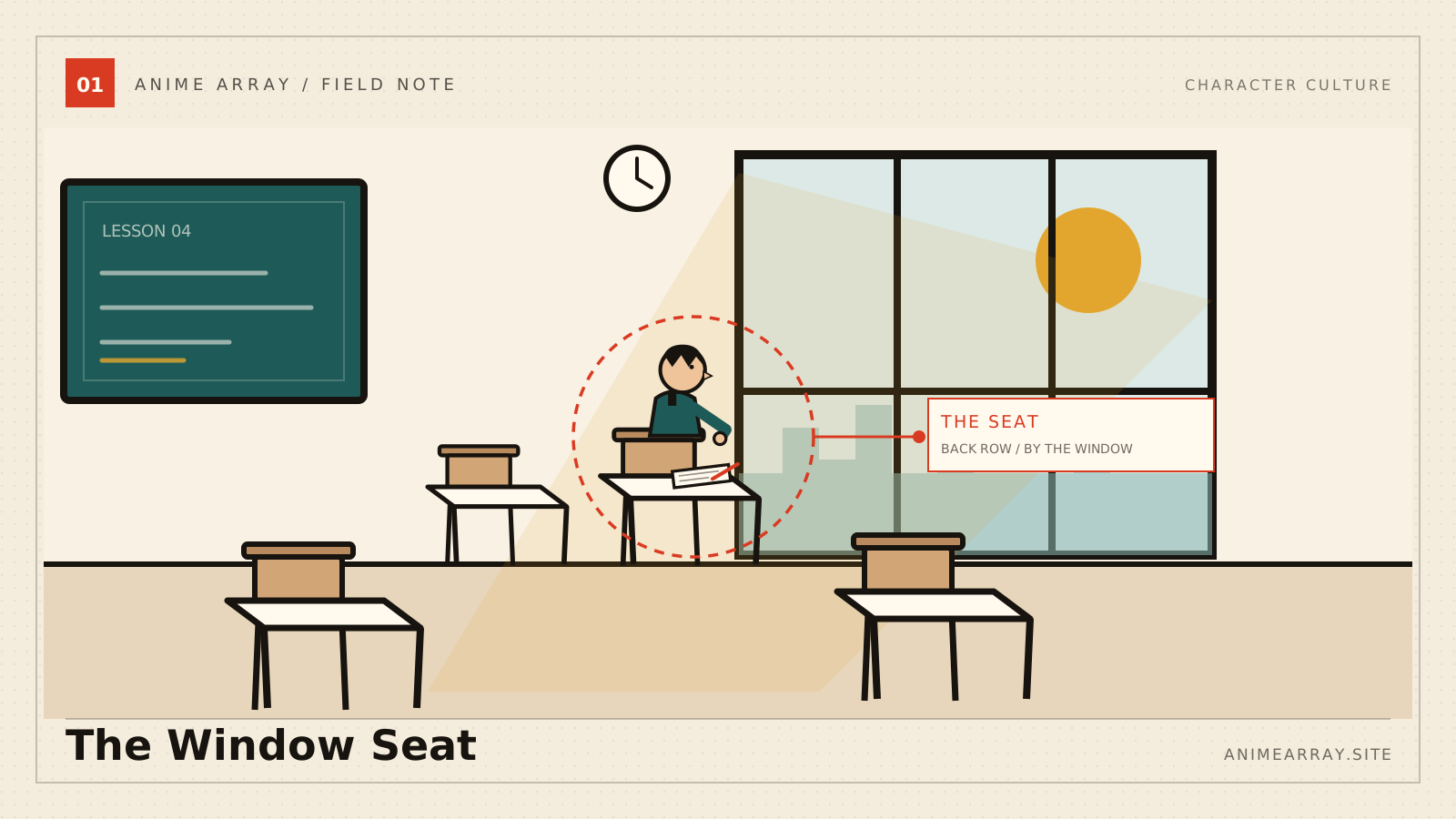
The back-row window seat is not a coincidence. It is one of anime’s most efficient pieces of staging—and a masterclass in solving three problems with one desk.
 Anime Array Editorial
7 min read
On this page
Watch enough school anime and you can predict the seating chart. The protagonist will be in the back row, usually last or second-to-last, beside a window. The frame will be open on one side: sky, power lines, a sports field, rain. They will look out of it while the teacher talks. Then the story will begin.
It is tempting to call this a coincidence, or a lazy convention. It is neither. The window seat is one of anime's most efficient pieces of staging: a single location that solves production problems, establishes character, and gives the camera somewhere to look. The interesting part is not that the trope exists. It is how much work it does.
The seat is a real seat
Japanese high schools generally use a homeroom system. Students are assigned to a class and a seat at the start of the year, and they stay there for most of the day while teachers move from room to room. Lunch, downtime, and a surprising amount of social life happen at the same desk. The seat is not just where you sit in one class; it is your base of operations.
That makes the geography of the classroom matter. The front row is exposed to the teacher. The middle is the middle. The back row offers privacy, a wider view of the room, and the ability to do something other than pay attention. The window adds daylight, a view, and a socially acceptable reason to look away. Put a character there and you have a stage that is simultaneously public and private.
Anime did not invent the seat. It turned it into a visual grammar: this person is a little apart, even in a crowd.
Three production problems, one seat
The window seat is often described as a writing shortcut. It is also a production shortcut, and the two are connected. A single frame has to answer several questions at once: Where are we? Who is this? What are they feeling? How much will it cost to draw?
| Problem | How the seat solves it | Why it works |
|---|---|---|
| The frame needs a background | A window supplies sky, weather, and time of day | A changing background without building a new set |
| The room has too many people | The seat sits at the edge of the room | Fewer bodies to draw, animate, and keep on model |
| The character needs to think | Looking out of a window is legible as interiority | No dialogue required; the audience fills the silence |
| The scene needs a threshold | A window can be entered, watched, or broken | It connects the safe room to the outside world |
The first two are practical. The third is where the seat becomes storytelling. A character looking out of a window is doing something the audience already understands: leaving the room without moving. The window gives the animator a place to put the character's attention, and it gives the viewer a place to project.
This is why the seat survives even in shows with generous budgets. It is not just cheap. It is clear.
The observer problem
Most stories need a character who can watch before they act. The window seat is a physical version of that idea. The protagonist is inside the group but at its edge; close enough to hear the conversation, far enough to comment on it. They can be lonely without being isolated, curious without being the center of attention, and present without being fully participating.
That position is especially useful in the first act. A new student, a quiet kid, or a character with a secret can be introduced as an observer. The camera can follow their gaze instead of the teacher's lesson. The audience learns what they notice. Then, when the story needs them to step in, the seat has already established the distance they are crossing.
The glass becomes a screen between the self and the world: a season changing, a city continuing without them, someone waiting outside. The seat is not just a place to sit; it composes the character's relationship to everything else.
Why the back row, specifically
The back row is where the adult in the room has the least control. That makes it useful for comedy, secrecy, and small acts of rebellion: passing notes, sleeping, reading something else, whispering. It is also where a character can have a private reaction without the whole class turning around.
In a school story, the back row is a pocket of freedom. The window adds a view, but the row does the social work: this person has found a place to be alone in public. Anime returns to that feeling because it is visually elegant and emotionally recognizable.
The exceptions are the point
Not every protagonist gets the window seat, and the exceptions are worth noticing. An ensemble comedy may put its lead in the middle so the group can orbit them. A story about academic pressure may put them at the front, under the teacher's eye. A show that wants to break the trope may give the seat to the wrong character, or make the seat itself a joke.
The default is powerful precisely because it is a default. When a director moves the protagonist somewhere else, it means something. The seat is a tool, not a law. The best school anime know when to use it and when to make a point of refusing it.
How to read the seat in a scene
Next time you notice the trope, ask three questions:
- Who is framed alone? The seat is doing its job when the character has space around them, even in a crowded room.
- What is outside the window? Weather, a city, a person, a memory. The view is chosen, not accidental.
- When do they stop looking out? The moment the character turns from the window to another person is often the moment the story starts.
The window can mean freedom, boredom, danger, nostalgia, or a world the character cannot reach. The seat is the fixed point that makes those shifts legible.
The shortcut has a cost
The risk is monotony. If every quiet protagonist sits in the same corner, the loner becomes a type, the window becomes wallpaper, and an ensemble story loses the group it wants us to care about.
The fix is not to ban the seat. It is to vary the frame: put the character in the middle for a scene, let someone else occupy the window, show the classroom from the teacher's perspective. The seat is most powerful when it is a choice, not a reflex.
The bottom line
The window seat is not a secret code or a universal rule. It is a piece of staging that solves real problems: it gives the frame a background, the character a private pocket, and the story a way to show someone watching the world before they join it. That is a lot of work for one desk.
That is why it keeps showing up: anime is built from small, repeatable solutions, and this is one of the best.
Frequently asked
Is the window seat always at the back-left?
No. The common version is the back row—often the last or second-to-last—beside a window; the side depends on the classroom layout and the shot. The important part is the edge of the room, not a universal left/right rule.
Why do anime students always sit in the same seat?
Many Japanese schools use homerooms with assigned seats; students stay in one room while teachers move. That makes the seat a stable base for the story. The anime convention exaggerates it.
Is the trope a Japanese thing?
The school system is Japanese; the staging convention is a media habit. Directors around the world use window seats for the same visual reasons.
Sources and notes
- Justin Sevakis, “Why Do Anime Students Always Sit In The Same Seat?” Anime News Network, 2018. The article explains the Japanese homeroom system and the storytelling appeal of the back-row window seat.
- The Japan Forum, “Class, homeroom.” A short explanation of the homeroom system and how subject teachers move between classes.
This is an analytical essay, not a claim that every anime follows the same seating chart. Classroom layouts, school systems, and directorial choices vary.